
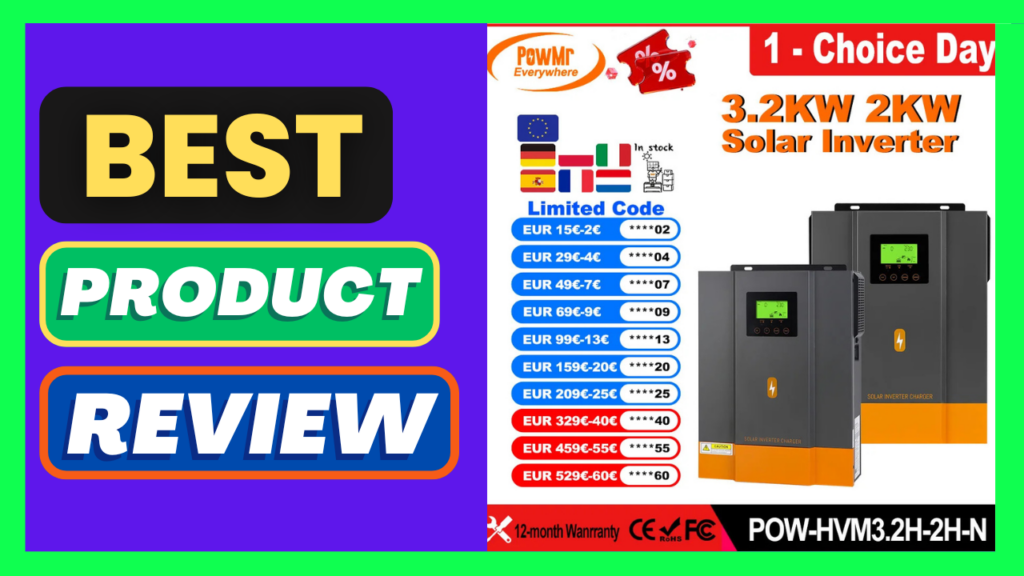
The PowMr 3.2kW 24V Hybrid Solar Inverter is an appealing all-in-one solution for DIY solar systems, backup power installations, cabins, workshops, and small off-grid homes. It combines a pure-sine-wave inverter, MPPT solar charge controller, battery charger, and automatic transfer functions into a single unit.
The exact specifications vary between PowMr’s 3.2kW models and regional versions, so it’s important to check the model number before buying. The POW-HVM3.2H-24V-N, for example, is rated at 3.2kVA/3.0kW, uses a 24V battery bank, provides pure-sine-wave AC output, and includes an MPPT solar charger. PowMr also publishes manuals for the different 3.2kW variants.
Overall, the inverter offers a lot of functionality for the money, but its budget positioning means buyers should pay particular attention to installation, electrical specifications, model compatibility, and long-term reliability.
All-in-One Design
The biggest advantage of the PowMr is its integrated design.
Instead of purchasing a separate inverter, solar charge controller, AC battery charger, and transfer switch, the PowMr combines these functions into one enclosure.
For a DIY solar installation, that can dramatically simplify the system.
The inverter can manage power from several sources, including solar panels, batteries, utility power, and in some configurations a generator. The HVM3.2H-24V-N supports different charging priorities, including solar-only, mains-priority, solar-priority, and combined mains-and-solar charging.
This flexibility is particularly useful for backup-power systems where you want solar to provide most of the energy but still have utility power available when the batteries are depleted.
3.2kW Output
The inverter is rated at approximately 3.2kVA, with the HVM3.2H-24V-N specified at 3.0kW continuous output.
That’s enough power for many typical household and workshop loads.
It can comfortably handle things such as:
- Refrigerators
- Lights
- Televisions
- Computers
- Fans
- Networking equipment
- Small power tools
- Pumps
- Kitchen appliances
However, 3kW is not enough to run every large appliance simultaneously.
High-power loads such as electric water heaters, ovens, large air conditioners, and electric heating equipment can quickly consume the available capacity.
It’s also important to account for startup surges. Motors and compressors can briefly require substantially more power than their running wattage.
Pure Sine Wave Output
One of the most important features is the pure sine wave AC output.
That’s preferable to modified-sine-wave inverters because many modern appliances and electronic devices are designed to operate from a clean sine-wave supply.
The HVM3.2H-24V-N is specified with pure-sine-wave output and approximately 230V AC output for the applicable version.
This makes it suitable for sensitive electronics as well as ordinary household loads.
Buyers should be careful, though, because PowMr sells different voltage versions. Some 24V models are designed for 110/120V systems, while others target 220/230V markets.
Choosing the correct regional version is essential.
MPPT Solar Charging
The built-in MPPT controller is one of the main reasons to choose the hybrid inverter.
MPPT technology continuously adjusts the operating point of the solar array to extract useful power as sunlight and panel conditions change.
The HVM3.2H-24V-N documentation lists an MPPT voltage range of approximately 30–400V DC, with a maximum PV open-circuit voltage of 400V and up to 3,000W of PV array power.
That gives you considerable flexibility when configuring a solar array.
However, solar-panel string design is extremely important. The array’s maximum open-circuit voltage must remain within the inverter’s limits under the coldest expected conditions.
This is not a product where you should simply connect panels together until the wattage looks right. Voltage, current, temperature coefficients, and the inverter’s exact specifications all need to be considered.
24V Battery System
The PowMr uses a 24V battery architecture.
A 24V system is a useful middle ground between 12V and 48V systems.
Compared with 12V, the higher voltage means lower current for the same power output, which can reduce cable size and voltage losses.
At the same time, 24V batteries and battery banks can be relatively affordable and easy to configure.
For example, a 24V battery bank can be built using two compatible 12V batteries in series.
The downside is that a 3kW inverter can still draw a substantial amount of current from a 24V battery.
At full load, the DC current can easily exceed 120A before accounting for inverter losses. That means appropriately sized cables, fuses, disconnects, busbars, and battery connections are essential.
Battery Compatibility
Depending on the exact model, PowMr supports various battery chemistries and user-configurable charging settings.
The HVM3.2H-24V-N documentation lists support for lithium and lead-acid configurations, while the newer PowMr product range also provides models intended for LiFePO4 batteries.
This flexibility is useful because users can configure the inverter around the battery technology they’re using.
However, lithium batteries deserve particular attention.
A LiFePO4 battery’s BMS and the inverter’s charging settings need to be compatible. Incorrect charging voltages or poorly configured low-voltage cutoffs can reduce battery life or cause unexpected shutdowns.
Anyone using lithium batteries should follow the battery manufacturer’s charging requirements rather than assuming a generic lithium preset is automatically correct.
Charging Options
The hybrid functionality is useful for backup systems.
The inverter can prioritize solar, utility power, or a combination depending on the selected operating mode. The documented charging modes include:
- Solar only
- Mains priority
- Solar priority
- Mains + solar hybrid
This makes it possible to configure the system according to your priorities.
For example, a user might prioritize solar during the day, store excess energy in the battery, and use grid power as a backup when solar and battery capacity are insufficient.
That type of flexibility is one of the strongest arguments for buying an all-in-one hybrid inverter.
UPS-Like Operation
The HVM3.2H-24V-N supports mains bypass and inverter output modes, with documented transfer times around 10ms in UPS mode and 20ms for certain appliance loads.
That can be useful for computers, networking equipment, security systems, and other devices where a short interruption could be inconvenient.
However, I wouldn’t automatically assume it provides the same seamless performance as a dedicated enterprise UPS.
For mission-critical equipment, it’s worth testing the actual configuration with the specific equipment you intend to protect.
Efficiency
PowMr specifies more than 95% efficiency in line mode for the HVM3.2H-24V-N and approximately 94% peak efficiency in inverter mode.
Those are respectable figures for a budget all-in-one inverter.
Real-world efficiency will vary depending on load level, battery voltage, temperature, and operating mode.
One important point is that the inverter consumes some power even when the connected appliances are using very little energy.
For a solar system intended to operate continuously, standby consumption matters, particularly overnight when there may be little or no solar generation.
Cooling and Noise
A 3kW inverter generates considerable heat under heavy loads.
The PowMr uses active cooling with internal fans.
This is effective at keeping temperatures under control, but it means the inverter isn’t completely silent.
Fan noise may be noticeable in a bedroom or living space, particularly when the inverter is operating at high power.
For a garage, utility room, workshop, or dedicated equipment area, this is much less of an issue.
Good ventilation is essential. An inverter should never be installed in a confined space where heat cannot escape.
Display and Controls
The front-panel display provides access to operating information and configuration settings.
You can monitor things such as battery status, solar input, load, and operating mode.
The interface isn’t as polished as what you’ll find on expensive modern energy-storage systems, but it provides the information necessary to configure and operate the inverter.
PowMr also maintains a dedicated online library containing manuals and configuration documentation for its inverter range.
For a DIY system, having access to the documentation is important because there are many settings that need to be configured correctly.
Installation
Installation is where the PowMr needs to be treated seriously.
A 3.2kW inverter connected to a 24V battery bank can involve very high DC currents.
A safe installation requires appropriately sized:
- Battery cables
- DC fuses
- Circuit breakers
- PV disconnects
- AC protection
- Grounding
- Busbars
- Battery connections
The solar array can also operate at several hundred volts DC on some versions, which is potentially lethal.
For that reason, this isn’t a simple plug-and-play appliance.
Anyone who isn’t experienced with high-current DC and mains-voltage electrical work should use a qualified installer.
Reliability
Reliability is probably the biggest question mark.
PowMr offers a compelling price and a large feature set, and there are many owners successfully using PowMr in DIY solar systems.
At the same time, owner experiences aren’t universally positive.
Recent community discussions include reports of unusual inverter behavior, charging problems, and concerns about reliability and after-sales support. For example, one 2026 user reported abnormal behavior when enabling solar input, including flickering fault indicators and problems with sensitive electronics.
Other owners have reported successful multi-kilowatt installations using PowMr equipment, demonstrating that the products can certainly work well when correctly configured.
This suggests a fairly typical budget-inverter trade-off: attractive specifications and price, but potentially less consistency and support than you’d get from premium brands.
Value for Money
Value is where the PowMr becomes particularly interesting.
A hybrid inverter that combines a pure-sine-wave inverter, MPPT controller, battery charger, and transfer functionality can eliminate several separate components.
That reduces equipment cost and can also simplify wiring.
For a DIY enthusiast building a cabin, workshop, backup system, or small off-grid installation, the savings can be significant.
The downside is that the inverter becomes a single point of failure.
If a separate inverter, charge controller, and charger are used, one component can fail while the others continue working. With an all-in-one unit, a failure can potentially take several functions offline simultaneously.
Who Should Buy It?
The PowMr 3.2kW 24V Hybrid Solar Inverter makes the most sense for:
- DIY solar enthusiasts
- Small off-grid installations
- Cabins and workshops
- Backup-power systems
- Small homes
- Solar hobbyists
- Users comfortable configuring electrical equipment
- Budget-conscious installations
It is less suitable for users who want a completely hands-off system or who require maximum long-term reliability and professional support.
For a mission-critical residential energy system, the additional cost of a more established premium inverter may be worthwhile.
Pros
- 3.2kVA-class output
- Around 3kW continuous output on the HVM3.2H-24V-N
- Pure sine wave
- Integrated MPPT solar controller
- 24V battery architecture
- Multiple charging modes
- Solar and utility input
- Battery charging capability
- UPS/bypass functionality
- Flexible battery compatibility depending on model
- High-voltage PV input on applicable versions
- Compact all-in-one design
- Good feature-to-price ratio
- Suitable for DIY and off-grid applications
Cons
- Specifications vary significantly between PowMr models
- 24V operation means high battery current at full load
- Cooling fans can be audible
- Requires careful electrical installation
- Budget-level build and support compared with premium brands
- Some owner reports raise reliability concerns
- After-sales support can be inconsistent
- High-voltage PV versions require serious electrical safety precautions
- All-in-one design creates a single point of failure
Final Verdict
The PowMr 3.2kW 24V Hybrid Solar Inverter is an impressive budget all-in-one solution for DIY solar and backup-power systems.
Its combination of a pure-sine-wave inverter, MPPT solar charging, battery charging, multiple operating modes, utility integration, and 24V battery support gives it a lot of functionality in a single box.
The ability to use solar, battery, and grid power according to different priorities is particularly useful. The HVM3.2H-24V-N’s documented 3.0kW output, MPPT controller, and multiple charging modes make it capable of serving as the central component of a relatively sophisticated small solar system.
The main compromise is reliability and support. Community feedback shows that many owners successfully use PowMr equipment, but there are also reports of charging problems and unusual behavior.
For a budget-conscious DIY installation, that trade-off may be acceptable.
For a system where uninterrupted power and long-term serviceability are more important than upfront cost, I’d be more inclined toward a higher-end inverter from a manufacturer with a stronger track record and support network.
Rating: 4.1/5
Bottom line: The PowMr 3.2kW 24V Hybrid Solar Inverter offers an excellent collection of features for the price and can form the heart of a capable small solar or backup system. Its pure-sine output, MPPT charging, flexible operating modes, and all-in-one design are its biggest strengths. Just verify the exact model’s voltage and PV specifications, size the 24V battery wiring and protection correctly, and recognize that you’re accepting some reliability and support uncertainty in exchange for the lower price.