
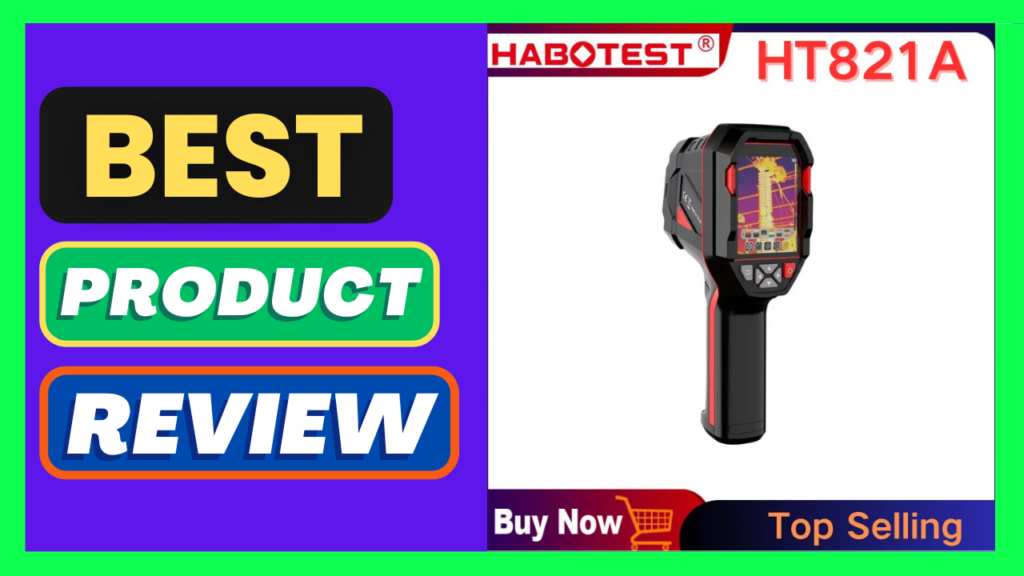
The HABOTEST HT821A is an affordable handheld thermal imaging camera designed for electrical troubleshooting, building inspections, HVAC work, automotive diagnostics, and general DIY use. It offers a useful combination of a wide temperature range, 25Hz refresh rate, rechargeable battery, multiple thermal color palettes, and a dedicated handheld design.
On paper, the HT821A looks particularly impressive because some listings describe a 240 × 240 thermal image. However, the underlying infrared sensor is actually 96 × 96 pixels, with software-enhanced output up to 240 × 240. That distinction is important when comparing it with more expensive thermal cameras.
For its intended budget-oriented applications, though, the HT821A can be a very useful diagnostic tool.
Design and Build Quality
The HT821A has the familiar pistol-grip design used by many handheld thermal cameras.
It measures approximately 220 × 74 × 107 mm and weighs around 377 grams, making it substantial enough to hold steadily without becoming excessively heavy during longer inspections.
The controls are straightforward, with dedicated navigation buttons, menu controls, an OK button, power button, and image-capture trigger.
This is one area where a dedicated thermal camera has a major advantage over a smartphone attachment. You can pick it up, turn it on, and start scanning without tying up your phone.
Thermal Imaging Resolution
The HT821A uses a 96 × 96 infrared sensor, providing 9,216 actual thermal pixels.
The device can use Super Resolution processing to produce a larger 240 × 240 displayed image, but this should not be confused with a native 240 × 240 detector.
That native resolution is perfectly usable for finding relatively large temperature differences, but it has limitations.
For example, the camera should be able to identify:
- Hot electrical connections
- Overheated components
- Heating pipes
- Cold spots
- Insulation problems
- HVAC temperature differences
- Radiator performance
- Water leaks associated with temperature differences
It won’t provide the same fine detail when inspecting tiny electronic components or distant objects as a thermal camera with a higher-resolution detector.
This is probably the most important limitation to understand before buying it.
Temperature Range
One of the HT821A’s strongest specifications is its wide measurement range.
It is specified to measure from approximately -20°C to 550°C (-4°F to 1022°F), with low- and high-temperature measurement modes.
That gives the camera considerably more versatility than basic thermal cameras intended only for home inspection.
You can use it for relatively cold surfaces as well as much hotter electrical, mechanical, or industrial components.
However, the maximum range doesn’t mean that every measurement across that entire range will have identical accuracy. The stated accuracy is ±2°C or ±2% of the reading, whichever is greater.
For general troubleshooting that’s reasonable, but it isn’t a substitute for a calibrated professional measurement instrument when exact temperature readings are critical.
Thermal Sensitivity
The HT821A is specified with a NETD of up to 40mK at 25°C, which is a respectable figure for an inexpensive thermal camera.
Lower NETD generally means the sensor is better able to distinguish small temperature differences.
In practical terms, this helps when you’re looking for subtle thermal patterns rather than extremely obvious hot or cold spots.
That can be useful for detecting differences across walls, windows, electrical panels, pipes, and mechanical equipment.
25Hz Refresh Rate
The camera provides a 25Hz frame rate.
That’s a nice feature for scanning around a room or moving the camera across machinery.
The image feels considerably more natural than with very low-refresh thermal cameras, making it easier to follow heat patterns as you move.
For building inspection and electrical troubleshooting, 25Hz is more than adequate.
It’s also useful for identifying moving heat sources or scanning large areas without the image feeling excessively choppy.
Field of View
The HT821A has a relatively wide 50° × 37.2° field of view.
That’s particularly useful for building and electrical inspections because you can capture a relatively large area without standing far away.
A wide field of view also makes it easier to scan walls, ceilings, floors, electrical panels, and HVAC equipment.
The trade-off is that small objects occupy fewer pixels when viewed from a distance, so you may need to move closer when trying to inspect small components.
Temperature Measurement
The camera can display minimum, maximum, and center-point temperature readings across the image.
This makes it much more useful than a simple infrared thermometer.
Instead of measuring one point at a time, you can see the entire thermal pattern and identify the hottest or coldest areas.
The HT821A also supports adjustable emissivity, which is important because different materials emit infrared radiation differently. The documented emissivity adjustment range is 0.01 to 0.99.
For accurate measurements, users need to understand emissivity and select an appropriate value for the material being measured.
This is especially important when working with shiny metals, which can produce misleading infrared readings.
Color Palettes
The camera provides multiple thermal color palettes, including options such as White Hot, Black Hot, Iron Red, Rainbow, Red Hot, and Cold Blue.
Having several palettes is useful because different scenes can be easier to interpret with different color schemes.
For example, Iron Red can make hot areas visually obvious, while a grayscale palette can sometimes make subtle temperature gradients easier to identify.
This is a small feature, but one you’ll appreciate once you start using the camera regularly.
Visible-Light Camera and Image Fusion
The HT821A includes a visible-light camera alongside the infrared sensor, allowing the device to provide visual context and fusion-style thermal images.
This is particularly useful when documenting an inspection.
A pure thermal image can sometimes make it difficult to tell exactly which physical component you’re looking at.
Combining visible and thermal information makes the resulting image easier to understand later.
For electricians, technicians, and home inspectors, this can be especially useful when saving images for reports.
Screen
The camera uses a 2.8-inch display.
It’s not a huge screen, but it’s appropriate for a handheld instrument.
The display is large enough to identify hot and cold areas and read the temperature information without making the device unnecessarily bulky.
The main limitation is that detailed analysis is naturally easier on a computer than on the camera’s small built-in screen.
Rechargeable Battery
The HT821A has a built-in rechargeable lithium battery.
Documentation for different HT821A variants lists batteries around 2,000–2,600mAh, with some specifications claiming approximately five hours of operating time.
The USB-C connection is convenient because charging doesn’t require a proprietary power adapter.
For most inspection sessions, several hours of operation should be more than sufficient.
The rechargeable design is also preferable to constantly replacing disposable batteries.
Image and Video Recording
The HT821A can save thermal images and, depending on the specific firmware/version, thermal video. Documentation lists JPG image storage and MP4 video recording, along with internal storage.
This is useful for documenting problems rather than simply viewing them in real time.
For example, if you discover an unusually hot electrical connection, you can capture the image and use it later when discussing the problem with a technician or documenting maintenance work.
Storage specifications vary between documentation sources and variants, with references to 8GB and 16GB internal storage, so buyers should confirm the exact configuration of the unit they are ordering.
Building Inspection
The HT821A is particularly useful around the house.
Thermal imaging can help identify suspicious temperature patterns around:
- Windows and doors
- Exterior walls
- Ceilings
- Radiators
- HVAC vents
- Pipes
- Electrical outlets
- Circuit breakers
- Appliances
For example, an unusually cold section of a wall may indicate an insulation problem, while a localized hot area around an electrical connection can indicate a potential issue requiring further investigation.
A recent hands-on video review specifically demonstrated applications such as identifying thermal bridges, energy losses, and installation problems, suggesting that this type of use is well suited to the HT821A.
Electrical Troubleshooting
Electrical work is another strong application.
A thermal camera can reveal abnormal heating that isn’t necessarily visible to the naked eye.
You can scan:
- Breaker panels
- Fuses
- Terminals
- Switches
- Motors
- Power supplies
- Connectors
- Cables
- Circuit boards
A loose or overloaded connection may produce a localized heat signature that stands out from surrounding components.
However, thermal imaging should be considered a diagnostic aid rather than definitive proof of an electrical fault. Any potentially dangerous electrical issue should be investigated using appropriate procedures and test equipment.
HVAC and Plumbing
The wide field of view and temperature range also make the HT821A useful for HVAC and plumbing work.
You can follow temperature differences along pipes and ducts, compare supply and return temperatures, and look for areas where heating or cooling isn’t behaving as expected.
It’s also useful for identifying suspicious cold or warm areas associated with possible water leaks.
Thermal imaging doesn’t actually “see” water through walls, but moisture can create a temperature difference that becomes visible under suitable conditions.
That distinction is important because a thermal camera identifies temperature patterns, not water itself.
Automotive Diagnostics
The camera can also be useful for automotive troubleshooting.
You can inspect:
- Radiators
- Brake components
- Wheel bearings
- Electrical connections
- Batteries
- Motors
- Exhaust components
- HVAC systems
A thermal image can reveal uneven heating that may point toward a problem.
For example, comparing the temperatures of different brake components can provide useful clues about abnormal heat distribution.
Again, the camera is best used as one diagnostic tool rather than the only method of determining whether a component has failed.
Ease of Use
The HT821A is relatively approachable for beginners.
The dedicated buttons are more practical in a workshop environment than a complicated smartphone application, and the pistol-grip design makes it easy to scan surfaces.
The basic workflow is simple:
- Turn the camera on.
- Point it at the target.
- Observe the thermal pattern.
- Check the temperature readings.
- Adjust emissivity if necessary.
- Capture an image when you find something interesting.
The more advanced concepts—especially emissivity, reflected temperature, measurement distance, and thermal interpretation—take more time to learn.
That’s true of virtually every thermal imaging device.
Accuracy
The stated accuracy of ±2°C or ±2%, whichever is greater, is reasonable for a consumer/DIY thermal camera.
For finding temperature differences, accuracy is often less important than consistency.
If one electrical terminal is dramatically hotter than the others, you may not care whether the actual temperature is 72°C or 74°C—the difference itself is the useful information.
For laboratory work, safety-critical measurements, or applications where exact temperature certification is required, a professional calibrated thermal imager would be a better choice.
Resolution Limitations
This is the area where expectations need to be managed.
The 96 × 96 native detector is adequate for general diagnostics, but it isn’t a high-resolution thermal sensor.
The 240 × 240 Super Resolution output makes the displayed image look more detailed, but it doesn’t create genuine new thermal information at the sensor level.
For large targets such as walls, electrical panels, HVAC equipment, and machinery, the resolution is usually sufficient.
For tiny components, fine PCB traces, or distant objects, you’ll want a higher-resolution thermal camera.
Value for Money
The HT821A’s biggest advantage is its combination of functionality and relatively low cost.
You get a dedicated handheld thermal imager with a rechargeable battery, 25Hz refresh rate, broad temperature range, multiple palettes, adjustable emissivity, image storage, and a visible-light camera.
That’s a lot of capability for a budget instrument.
Recent thermal-imaging discussions also show that inexpensive handheld cameras with roughly 90 × 90-class sensors can be perfectly useful for practical tasks such as finding thermal leaks, even though they obviously don’t compete with high-end professional cameras.
The key is buying it for the right purpose.
Pros
- Affordable dedicated handheld thermal camera
- 96 × 96 native infrared resolution
- Software-enhanced 240 × 240 output
- 25Hz refresh rate
- Wide 50° × 37.2° field of view
- Up to 550°C measurement range
- -20°C low-temperature measurement
- NETD up to 40mK
- Adjustable emissivity
- Multiple color palettes
- Minimum, maximum, and center temperature readings
- Visible-light camera/fusion capability
- Rechargeable lithium battery
- USB-C charging
- Around five hours of claimed operation on applicable variants
- Image and video recording
- Compact handheld design
- Useful for electrical, HVAC, automotive, and home inspection
Cons
- Native thermal resolution is only 96 × 96
- 240 × 240 output is software enhanced rather than native
- Not ideal for tiny components or distant targets
- Temperature accuracy isn’t suitable for precision laboratory work
- Different listings report slightly different battery/storage specifications
- Emissivity must be configured correctly for accurate measurements
- Small display limits detailed analysis
- Advanced professional features are limited
Final Verdict
The HABOTEST HT821A is a capable budget thermal imaging camera that makes thermal inspection accessible without the cost of a professional instrument.
Its 25Hz refresh rate, wide field of view, useful temperature range, adjustable emissivity, rechargeable battery, and dedicated handheld design make it practical for home inspections, electrical troubleshooting, HVAC work, automotive diagnostics, and general DIY projects.
Its biggest weakness is also the most important specification to understand: the camera uses a 96 × 96 native infrared sensor, not a true 240 × 240 detector. The larger 240 × 240 image is generated through Super Resolution processing.
That isn’t necessarily a problem. For finding hot electrical connections, cold spots, insulation problems, uneven heating, and other relatively large thermal patterns, 96 × 96 can be surprisingly useful.
The HT821A becomes less attractive when you need to inspect very small objects, resolve fine PCB details, or make highly precise temperature measurements.
For the average homeowner, DIY enthusiast, electrician, mechanic, or technician who wants an affordable thermal camera for troubleshooting, however, it offers an impressive amount of functionality.
Rating: 4.3/5
Bottom line: The HABOTEST HT821A is a strong entry-level thermal camera with a useful feature set and practical handheld design. It won’t replace a professional high-resolution thermal imager, but for finding heat loss, electrical hotspots, HVAC problems, and other temperature anomalies, it provides an excellent introduction to thermal imaging without requiring a major investment.