
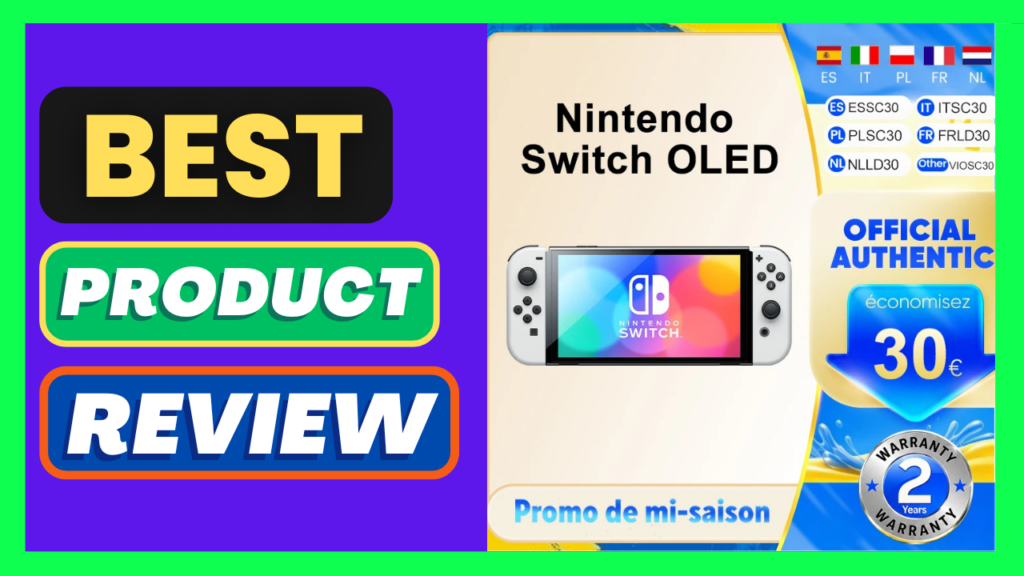
The Nintendo Switch OLED Model remains one of the most enjoyable hybrid gaming consoles available, combining handheld gaming with traditional TV play in a compact and versatile package. While it doesn’t represent a major performance upgrade over the original Switch, the OLED version improves several areas that matter during everyday use, particularly the display, audio, kickstand, and overall handheld experience.
For gamers who frequently play in handheld or tabletop mode, these improvements make the OLED model feel noticeably more premium.
OLED Display
The biggest upgrade is the 7-inch OLED screen.
Compared with the 6.2-inch LCD display on the standard Nintendo Switch, the OLED panel produces much deeper blacks, stronger contrast, and more vibrant colors. Games such as The Legend of Zelda: Tears of the Kingdom, Mario Kart 8 Deluxe, and Super Mario Bros. Wonder look especially impressive on the larger display.
The increased screen size also makes handheld gaming more comfortable. Text and smaller visual details are easier to see, while the improved contrast makes darker games look considerably better.
The resolution remains 1280 × 720 in handheld mode, so Nintendo hasn’t increased pixel count. The improvement comes primarily from OLED technology, screen size, and color reproduction rather than higher resolution.
Joy-Con Experience
The included Joy-Con controllers retain the familiar Nintendo design and can be attached directly to the console or used separately.
They’re excellent for casual multiplayer because two people can quickly share the Joy-Con controllers without needing another complete controller.
The biggest advantage is versatility. You can use them attached to the console in handheld mode, detached for tabletop gaming, or connected to the included grip for a more traditional controller-style setup.
However, the Joy-Con design isn’t perfect. Some users may find the small buttons and compact analog sticks less comfortable during long gaming sessions. The well-known history of Joy-Con stick drift is also something prospective buyers should keep in mind.
For extended sessions, a more traditional controller can provide a better ergonomic experience.
Improved Audio
Nintendo also improved the built-in speakers on the OLED model.
The speakers provide clearer and more powerful sound than the original Switch, particularly when playing in handheld or tabletop mode.
This makes a meaningful difference when you’re gaming without headphones. Dialogue, music, and sound effects are easier to hear, and the overall presentation feels less thin.
It’s still a small portable console, so it can’t compete with a dedicated sound system, but the improvement is noticeable.
Bluetooth audio support also makes it easier to use compatible wireless headphones without additional adapters.
Adjustable Kickstand
The original Switch’s small kickstand was one of its weakest physical features.
The OLED model fixes this with a wide, adjustable rear kickstand that runs across much of the back of the console.
It’s significantly more stable and allows you to adjust the viewing angle.
This makes tabletop gaming much more practical, particularly when using the console with detached Joy-Con controllers.
The kickstand is one of those improvements that may not sound exciting on paper but makes the console considerably nicer to use in real life.
Dock and TV Gaming
The OLED model comes with an updated dock that includes a wired LAN port.
This is useful for players who regularly play online games in TV mode because a wired Ethernet connection can provide a more stable connection than Wi-Fi in many home environments.
The console itself can still be connected to a television through HDMI, and the overall docked experience remains essentially the same as the standard Switch.
One important thing to remember is that the OLED model doesn’t provide a major increase in gaming performance.
Games generally run at the same frame rates and resolutions as they do on the standard Switch.
You’re paying for a better overall experience rather than a faster console.
Storage
The OLED model includes 64GB of internal storage, double the 32GB found in the original Switch.
That’s a welcome improvement, although serious digital-game users will probably still want a microSD card.
Modern games can consume tens of gigabytes, so the internal storage can fill surprisingly quickly if you purchase many games digitally.
Fortunately, expandable storage makes upgrading straightforward.
Portability
Portability remains one of the Switch’s greatest strengths.
The OLED model is compact enough to take on trips while still providing a proper console-style gaming experience.
You can play handheld games on the train, use tabletop mode while traveling, or connect the system to a TV when you get home.
That flexibility is difficult to replicate with a traditional console.
The OLED version is slightly heavier than the standard model, but the difference isn’t significant enough to make it feel cumbersome.
Gaming Performance
Performance is essentially the same as the standard Switch.
The OLED model doesn’t introduce a dramatically faster processor or GPU, so existing games don’t suddenly run at higher frame rates simply because you’re using the OLED version.
This is an important consideration for buyers.
If you already own a standard Switch and are primarily interested in better performance, upgrading to the OLED model may not make financial sense.
But if you’re buying your first Switch, the OLED model is arguably the nicest version of the original Switch hardware.
User Experience
Nintendo’s software remains one of the console’s biggest strengths.
The interface is simple, games are easy to access, and switching between handheld, tabletop, and TV modes is extremely convenient.
The console also has access to Nintendo’s excellent first-party library, including major franchises such as Mario, Zelda, Pokémon, Kirby, Metroid, and Animal Crossing.
The combination of Nintendo exclusives and the hybrid form factor makes the Switch OLED particularly appealing to families and casual gamers.
What Could Be Better?
The biggest weakness is that the OLED model is not a true performance upgrade.
If you’re expecting substantially better graphics or higher frame rates, you’ll be disappointed.
The console also remains relatively expensive considering that the underlying performance is similar to the original Switch.
The Joy-Con controllers remain small, and long-term durability concerns surrounding analog sticks can be a consideration.
Battery life is also good rather than exceptional, depending on the game being played.
Finally, the OLED display is excellent, but its advantages disappear when you’re playing primarily in TV mode.
Pros
- Beautiful 7-inch OLED display
- Excellent contrast and vibrant colors
- Larger screen than the standard Switch
- Improved built-in speakers
- Excellent adjustable kickstand
- 64GB internal storage
- LAN port on the dock
- Flexible handheld, tabletop, and TV modes
- Huge Nintendo game library
- Compact and highly portable
- Joy-Con controllers provide excellent multiplayer flexibility
- Very easy to use
Cons
- No significant performance improvement over the standard Switch
- Same basic resolution as the original model
- Joy-Con ergonomics aren’t ideal for everyone
- Joy-Con stick-drift concerns remain
- More expensive than the standard Switch
- Internal storage can still fill quickly
- OLED benefits are limited when playing primarily on a TV
Final Verdict
The Nintendo Switch OLED Model is the best version of the original Nintendo Switch hardware for gamers who value handheld and tabletop gaming.
Its 7-inch OLED display is the standout feature, providing richer colors, deeper blacks, and a more immersive handheld experience. The improved speakers, excellent adjustable kickstand, larger storage capacity, and LAN-equipped dock add further refinement.
The biggest caveat is performance. This isn’t a “Switch Pro.” Games don’t suddenly run dramatically faster, and the underlying hardware is broadly similar to the standard Switch.
That makes the OLED model much easier to recommend to new buyers than to existing Switch owners.
If you’re buying your first Switch and want the best version of the original console, the OLED model is an excellent choice. If you already have a functioning standard Switch, the upgrade is mainly worthwhile if you spend a lot of time playing handheld and really appreciate a better screen.
Rating: 4.6/5
Bottom line: The Nintendo Switch OLED Model doesn’t reinvent the Switch, but it refines it in all the right places. The gorgeous OLED screen, improved audio, better kickstand, larger storage, and versatile Joy-Con setup make it a fantastic hybrid console, even if its unchanged performance keeps it from being a must-have upgrade for existing owners.