
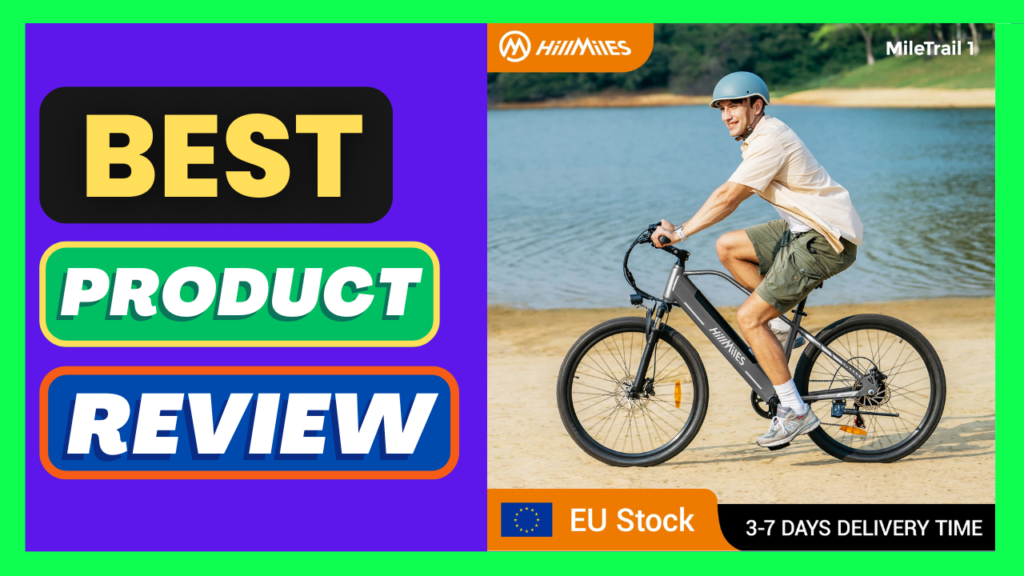
The HillMiles MileTrail 1 is an electric bike that sits somewhere between a commuter and a recreational mountain bike. It has the aggressive styling and 26-inch tires you’d expect from an e-MTB, but its practical design also makes it well suited to everyday transportation, paved roads, bike paths, and light off-road riding.
What makes the MileTrail particularly interesting is its combination of a 36V 13Ah battery, 250W motor, torque-sensor pedal assistance, 7-speed gearing, front and rear suspension, and hydraulic disc brakes on some current-market versions. HillMiles lists a maximum assisted speed of 25 km/h on its standard European listing, while its U.S. listing specifies up to 20 mph (32 km/h).
It’s not a replacement for a high-end mountain bike, but as an affordable electric bike for commuting and recreational trail use, the MileTrail offers a lot of equipment for the price.
Design and Build Quality
The first thing you notice about the MileTrail is its mountain-bike-inspired appearance.
The 26-inch wheels, relatively wide tires, suspension setup, and sturdy frame give it a substantial look. HillMiles lists the frame as high-carbon steel and specifies a maximum payload of 120kg on its standard listing.
That sturdy construction does come with a downside: the bike is heavy. The standard HillMiles listing puts the weight at approximately 33.17kg, which is considerably heavier than a conventional mountain bike.
This isn’t a bike you’ll want to carry up several flights of stairs regularly.
Once you’re riding, however, the weight feels less problematic because the motor provides assistance.
Motor Performance
The MileTrail 1 uses a 250W electric motor, with current listings also emphasizing torque-sensor assistance. The European HillMiles site lists a torque sensor and a 25 km/h maximum assisted speed, while the U.S. listing specifies 32 km/h/20 mph.
The motor is aimed more at smooth assisted riding than extreme performance.
On flat roads, it provides enough assistance to make commuting noticeably easier. The biggest benefit becomes apparent when accelerating from a stop or climbing moderate hills.
A torque sensor is particularly welcome here.
Instead of simply delivering assistance based on how quickly you’re pedaling, a torque sensor responds to how hard you’re pushing the pedals. That generally produces a more natural riding experience because the motor increases assistance when you put more effort into the pedals.
For riders who don’t like the abrupt feeling sometimes associated with cadence-only systems, this is one of the MileTrail’s strongest features.
Hill Climbing
Despite the relatively modest 250W motor rating, the MileTrail can handle ordinary inclines reasonably well when the rider contributes some pedal effort.
It’s important not to confuse this with a high-powered off-road e-bike.
Very steep hills, loose surfaces, and heavier riders will put considerably more demand on the motor. On challenging climbs, maintaining momentum and using the appropriate gear becomes important.
The 7-speed drivetrain helps here because you can select a lower gear before tackling an incline.
For normal city hills, gravel paths, and moderate trails, the combination of gearing and electric assistance should be adequate.
For very steep mountain terrain, riders looking for serious off-road performance will probably want a more powerful e-MTB.
Battery and Range
The MileTrail 1 uses a 36V 13Ah battery, which works out to roughly 468Wh of nominal energy.
HillMiles claims approximately 50–65km of pure-electric range and up to 80–100km with maximum pedal assistance, based on a 75kg rider.
Those numbers are best treated as optimistic maximum figures.
Actual range depends on rider weight, terrain, temperature, wind, tire pressure, riding speed, assist level, and how frequently the motor is required to climb hills.
If you’re riding mostly on relatively flat roads with plenty of pedal assistance, a long-distance ride is realistic.
If you’re riding aggressively through hills and using high assistance continuously, expect considerably less.
That’s normal for an e-bike in this battery class.
Torque Sensor
The torque sensor is one of the MileTrail’s most appealing features.
It makes the motor response feel more connected to your pedaling.
When you push harder, the system provides more assistance; when you ease off, the motor reduces its contribution.
This makes it easier to control your pace on mixed terrain.
A torque-sensing system can also encourage you to keep pedaling rather than simply relying on the motor, which is useful if you want some exercise while still having electric assistance available for hills and longer distances.
A hands-on review published by Tuttotech specifically highlighted the MileTrail’s torque sensor and described the model as a competitively priced option with a more sporty, mountain-bike-style design.
Suspension
The MileTrail is equipped with a front and rear suspension system according to HillMiles’ product information.
This gives it an advantage over rigid commuter e-bikes when riding over rougher surfaces.
On broken pavement, gravel, grass, and light trails, the suspension helps reduce the harshness transmitted through the frame and handlebars.
However, buyers should keep their expectations realistic.
This is an affordable electric bike, not a purpose-built downhill mountain bike.
The suspension is best thought of as a comfort and light-trail feature rather than equipment intended for jumps, aggressive downhill riding, or technically demanding mountain-bike trails.
Tires and Handling
The 26-inch mountain-bike tires provide a good compromise between stability and maneuverability.
They’re large enough to roll comfortably over uneven surfaces while remaining relatively easy to control at lower speeds.
On pavement, the tires can produce more rolling resistance than narrow road-bike tires, but that isn’t necessarily a problem because the motor compensates for much of it.
On gravel and dirt, the additional traction becomes more valuable.
The bike feels more at home on mixed surfaces than a typical city e-bike.
Braking
Braking equipment varies by MileTrail version and market.
HillMiles’ current U.S. listing describes hydraulic brakes, while another official MileTrail listing specifies mechanical disc brakes.
This is an important point for buyers: check the exact specification of the version you’re purchasing.
Hydraulic disc brakes offer excellent stopping power and generally require less hand effort, making them particularly useful on a heavy e-bike.
Mechanical disc brakes are easier to service and can still provide good performance when properly adjusted.
Either way, disc brakes are appropriate for a bike of this weight.
Gearing
The MileTrail uses a 7-speed drivetrain.
Seven gears aren’t excessive, but they’re sufficient for the bike’s intended use.
You can select a lower gear for hills and a higher gear for faster sections of pavement.
Combined with electric assistance, the gearing doesn’t need to be as extensive as it would on a conventional bicycle.
The important thing is learning to shift before rather than during a difficult climb.
Comfort
Comfort is one of the MileTrail’s strongest characteristics.
The suspension, relatively large tires, upright riding position, and torque-assisted motor make it easy to settle into a relaxed pace.
The adjustable handlebar setup is also useful for finding a comfortable riding position. Current owner feedback on HillMiles’ U.S. site includes praise for the bike’s comfort, handling, and straightforward assembly.
For longer recreational rides, these small ergonomic details matter.
Display and Controls
The MileTrail includes an integrated display and controls for managing the electric assistance.
The system provides useful riding information such as speed and battery status, while the controls allow you to change the assistance level.
It’s a fairly conventional arrangement, so riders familiar with e-bikes should have little trouble getting used to it.
The controls aren’t as sophisticated as those on premium e-bikes, but they’re functional and easy enough to understand.
Lighting and Accessories
HillMiles includes integrated lighting, with the product information describing a bright LED headlight and brake light.
That’s a useful addition for commuting.
The bike also comes with mudguards on the standard listing, which can make a surprisingly big difference when riding on wet roads or muddy paths.
These aren’t glamorous features, but they’re exactly the sort of practical equipment that makes an e-bike more useful for everyday transportation.
Weather Resistance
The MileTrail is listed with an IPX4 water-resistance rating.
That means it can handle splashes and light rain, but it shouldn’t be treated as waterproof.
It’s perfectly reasonable to ride it in normal wet conditions with appropriate care, but prolonged heavy rain, standing water, or pressure washing should be avoided.
As with any e-bike, keeping the electrical connectors, display, battery contacts, and charging port protected is important.
Assembly
The bike arrives partially assembled, so some setup is required.
The package includes assembly tools and a manual, and current customer feedback on HillMiles’ U.S. store suggests that assembly can be completed relatively easily. One recent owner reported having the bike assembled and ready to ride in under an hour.
Even so, it’s worth carefully checking:
- Brake adjustment
- Handlebar alignment
- Wheel attachment
- Pedal installation
- Tire pressure
- Gear shifting
- Suspension settings
- All fasteners
A quick professional safety check is also worthwhile if you’re not comfortable working on bicycles.
Real-World Riding
The MileTrail makes the most sense as a versatile all-rounder.
On city streets, the motor takes much of the effort out of acceleration and hills.
On bike paths, the suspension and tires provide a comfortable ride.
On gravel and light trails, the mountain-bike-style geometry becomes more useful.
The bike’s biggest weakness in everyday use is its weight.
At more than 33kg according to one current official listing, it isn’t especially convenient to load into a car or carry upstairs.
However, if your riding begins and ends at home, that weight becomes much less significant.
Range in the Real World
The advertised 80–100km maximum pedal-assist range is attractive, but riders shouldn’t assume that figure is guaranteed.
For a lighter rider on relatively flat roads using moderate assistance, long distances are certainly plausible.
On hilly terrain, at higher speeds, or with a heavier rider, range can fall significantly.
This is a general characteristic of e-bikes rather than a specific flaw in the MileTrail.
The best approach is to treat the advertised figure as an upper-end estimate and plan longer rides with some battery reserve.
Who Is It For?
The MileTrail is particularly well suited to:
- Daily commuters
- Recreational riders
- Riders who want electric assistance on hills
- Beginners moving into e-bikes
- Riders who use paved and gravel surfaces
- People who want a mountain-bike appearance
- Riders looking for a comfortable, affordable e-bike
It’s less appropriate for:
- Serious downhill mountain biking
- Technical singletrack
- Riders who need an exceptionally lightweight bicycle
- People who frequently carry their bike upstairs
- Riders expecting motorcycle-like acceleration
Pros
- Natural-feeling torque-sensor assistance
- 36V 13Ah battery
- Claimed pedal-assist range up to 80–100km
- 250W motor suited to everyday riding
- 7-speed drivetrain
- 26-inch mountain-bike tires
- Front and rear suspension
- Disc braking
- Integrated LED lighting
- Practical commuter/trail design
- 120kg listed payload capacity
- Comfortable upright riding position
- Good value-oriented equipment package
Cons
- Very heavy at around 33kg on the standard listing
- 250W motor isn’t intended for extreme climbs
- Advertised maximum range is unlikely under demanding conditions
- Braking specifications vary between versions, so buyers need to check their exact model
- IPX4 rating doesn’t make it suitable for heavy water exposure
- Not designed for aggressive technical mountain biking
- Some regional versions have different speed limits and equipment
Final Verdict
The HillMiles MileTrail 1 is a well-equipped electric bike that successfully combines commuter practicality with light mountain-bike capability.
Its strongest feature is arguably the torque-sensor pedal assistance. Instead of feeling like you’re simply being pushed along by an electric motor, the assistance responds naturally to your effort. Combined with seven gears, suspension, and wide 26-inch tires, the result is a comfortable bike for mixed terrain.
The 36V 13Ah battery provides a useful amount of range, and HillMiles’ claimed 80–100km maximum pedal-assist range is competitive for this class.
The biggest drawback is weight. At around 33kg on the standard specification, the MileTrail is much heavier than a conventional bicycle, and that becomes noticeable whenever you need to carry or transport it.
It’s also important to verify the exact regional version before buying, because specifications such as maximum speed and brake type differ between current listings.
For commuting, weekend rides, paved roads, gravel paths, and moderate trails, however, the MileTrail offers a compelling combination of comfort, range, and electric assistance.
Rating: 4.4/5
Bottom line: The HillMiles MileTrail is a strong value-oriented e-bike for riders who want one bicycle that can handle commuting and recreational off-road riding. Its torque sensor, suspension, 7-speed gearing, practical accessories, and useful battery range make it enjoyable and versatile. Just be prepared for the substantial weight and remember that this is a light-trail electric bike rather than a serious technical mountain bike.